
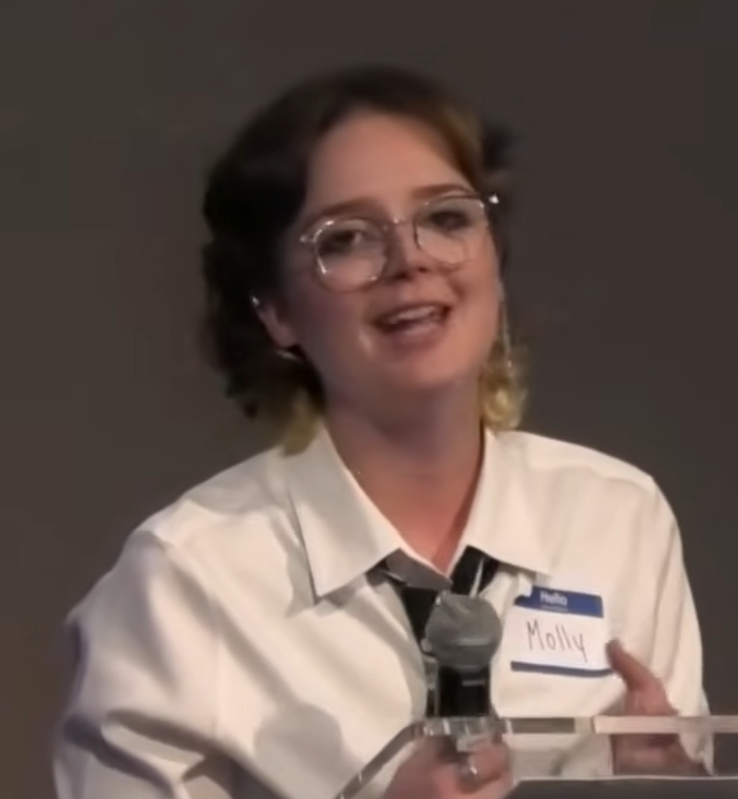
Decatur, Georgia
Before I was a topic of political debate, I was a kid trying to figure out who I was. As a child, I knew I liked wearing masculine clothes and knew I felt something different about me compared to girls around me.
But I didn’t have the language to understand what that difference meant.
I mostly thought I was just a girl who wasn’t that good at being a girl.
I remember other kids asking if I was a boy or a girl and loving when that happened,but not understanding why. The summer before ninth grade, the girls in my summer camp cabin gathered around me to do my makeup and put me in dress after dress until they found the right one. We all recognized I wasn’t exactly doing femininity correctly, and they responded with an easy, generous kind of solidarity.
I remember deciding in that moment to be a girl and to try to be good at it. I tried for years to recreate the ease with which they seemed to present themselves. It wasn’t until college when I encountered language that finally helped me understand myself, that I became comfortable in my own identity.
I finally understood the feeling of difference I had carried for so long.
I am non-binary.
My family’s response was remarkably ordinary. There was no dramatic coming out moment, just many small conversations over many years. When I told my sister, her response was essentially, “Yeah, duh, of course.”
And my mom actually asked me before I told her anything: “What is your gender?”
She knew something was going on and came to me with curiosity. My larger family hasn’t always understood everything about my identity, but they’ve
consistently approached it with a desire to understand. Most of them, anyway.
I recognize how fortunate I am. I had the safety and support to figure myself out slowly. I had people who didn’t require me to have all the answers immediately. I could explore who I was without worrying that doing so would cost me my family, my home, or my future. That’s where conversations about policy become very real for me. When we talk about bathrooms, sports, gender-affirming care, what schools should or shouldn’t allow, it can be easy to talk about trans people as a political
category. But those categories are made up of individual people, people with families, people who go to school, people trying to figure out who they are and imagine what their futures might look like.
And not everyone gets the kind of support I had. I’ve seen some of these stakes in my own classroom. My first job after college was teaching middle school. On my first day, I gave students the option of putting their pronouns on their nameplates.
Crazy idea. That evening, I received an email from a parent accusing me of trying to turn kids gay. What followed was a year of hostility, including an attempt by that family to corner me in my classroom on back-to-school night, and their removal by the principal, and many, many phone calls to the school.
On another occasion, during a school trip to Charleston, a trans student was harassed in a bathroom. On the bus afterward, students began chanting that there were only two genders. With the help of an administrator, we kept the student safe for the rest of the trip, but the wider school culture didn’t change. And ultimately, that student left the school because of the harassment they had experienced from students and parents alike.
This is the part I don’t want us to lose sight of. The question isn’t simply what do we believe about gender. It’s also what happens to the people who have to live with the consequences of what we decide. With dozens of anti-LGBTQ+ bills being proposed in Georgia alone, schools and young people have become a major target.
It’s daunting, and it can feel as though danger and darkness are creeping in. But every day, I’m reminded of the power of conversation, of meeting people where they are with a genuine desire to understand one another. I think we have a lot to learn from these students.
A fifth grader once asked me, “Are you a member of the rainbow community?” Which honestly might be the most respectful way anyone’s ever asked me that question.
I gave a simple yes. They asked, “Are you a boy or a girl?” I said, “Neither.”
They thought about that for a moment.
And then he asked, “Do you like boys or girls?” And I said, “Mostly boys.” And they said, “Okay.” That was it. They asked, I answered, they learned something. We moved on.
We don’t have to understand everything immediately. We can ask respectful questions, and we can teach children that difference is not inherently a threat.
I think there’s something important in this interaction that these children really, really can teach us, and sometimes these small moments of openness can have a much bigger impact than even I realize.
I think about another student I taught who spent study halls in my classroom and regularly gave me drawings to put on the walls. Over the course of the year, he kept me updated as he explored his gender identity and changed his pronouns. On the last day of school, he handed me a folded-up note and ran away as fast as possible. In it, he told me how meaningful it had been to see an openly queer adult. He had never known a trans adult before me, and seeing someone like him living an ordinary adult life helped him imagine a future for himself.
That note has stayed with me because it reminded me that representation doesn’t always have to be dramatic. Sometimes it’s simply seeing someone living an ordinary life and realizing you might get to have one, too.
I was lucky enough to have people that gave me the space to figure myself out, and I’ve been lucky enough to have opportunities to offer some of that space to my students.
What’s important in everything we do as people is creating the safety, dignity, and support for people to discover who they are for themselves and creating the kind of environment where they can share that discovery, listen to others, ask questions, and learn from perspectives different from their own.
Leave a Reply