
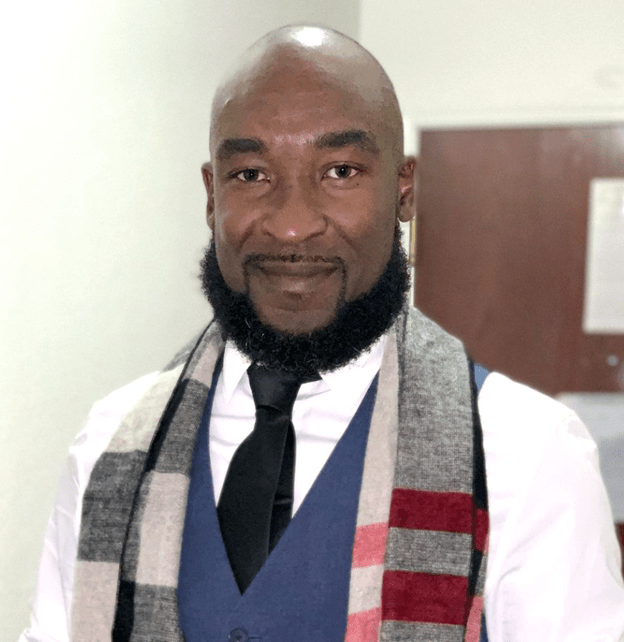
Loganville, Georgia
Incarceration took a toll on Rodney Taylor’s prosthetic legs. During his long stay at an immigrant detention center in Lumpkin, Georgia, Taylor was rarely able to get his batteries fully charged. That made bending painful, he told The Guardian in April 2025. Between his leg issues and a pair of ill-fitting, prison-issued shoes, taking a shower became an ordeal. Taylor often had to “drag his body through mold and feces to enter and exit the shower area,” Georgia Representative Lucy McBath told USA Today.
Getting medical attention inside the facility was also difficult. In his Guardian interview, Taylor recalled hearing one of the guards explain that “Unless you’re dying or bleeding out … they’re not going to come. They think, ‘Everybody is getting deported soon… and fixing your issue is not our concern – getting you outta here is our concern.’”
Taylor, now 47, was two years old when he left Liberia, the country that federal immigration officials intended to deport him to. “I didn’t even know I was an immigrant until I was 17 years old,” he told CNN, speaking from inside the facility.
Born with a host of limb problems, including a missing right foot and a clubbed left leg, he came to the U.S. on a medical visa for treatment at a Shriners Children’s Hospital. Both legs were eventually amputated and replaced with prosthetics. Taylor learned to walk over the course of a childhood marked by more than a dozen follow-up surgeries.
His family settled in Georgia to care for him, and his mother and father became U.S. citizens. Taylor himself “was not so fortunate,” as the journalist Sasha Abramsky put it in a Nation Magazine article about his case. As a teenager, he was arrested on a murky charge of residential burglary. “He could barely walk and there is doubt whether he could have physically committed the crime,” Abramsky observed. On his attorney’s advice, however, Taylor pled guilty, receiving a sentence of probation.
There is nothing murky about the course of his life from that point forward. With a surgically-built pinky finger that allowed him to grasp objects between his pinky and thumb, Taylor learned to cut hair and eventually established himself as a professional barber. Meanwhile, he raised a family and became active in his church and, as Abramsky wrote, “a fixture in his community—the man who would cut hair for free at back-to-school meets, church fundraisers, and breast-cancer awareness walks.”
None of this seemed to carry any weight with federal immigration officials, however. In January 2025, Immigration and Customs Enforcement agents arrested Taylor outside his home, surrounding him with guns drawn. “We didn’t know what was going on,” his fiancée (now his wife), told Fox 5 Atlanta. “It was like a scene from a movie.”
Taylor had received a pardon in 2010 from Georgia authorities who deemed him “a law-abiding citizen [who] is fully rehabilitated.” But they ducked the question of whether he had been guilty in the first place (his pardon should not be taken to “imply innocence,” they wrote), and ICE seized on that boilerplate language to assert that his pardon was incomplete and his record justified deportation.
Taylor finally won his release at the beginning of May 2026, after a massive campaign led by Representative Lucy McBath and Georgia Senator Raphael Warnock. Taylor, in a statement, described as “proof that when people organize and refuse to look away, we can win.”
More than 60,000 people remain in immigrant detention facilities, however, roughly 2000 of them at the Stewart Detention Center, where Taylor was held. Stewart is run by a private, for-profit company called CoreCivic. Like the private prison industry as a whole, CoreCivic has been the subject of many formal complaints, lawsuits, and federal investigations involving inadequate medical care, severe understaffing, and abuse and mistreatment of detainees. While the company insists that its facilities meet “high compliance standards,” the Biden administration took such criticisms seriously enough to announce, in January 2021, a plan to phase out the use of private companies throughout the federal justice system.
That prospect led the industry to donate many millions of dollars to Republican candidates in the next two election cycles. CoreCivic and the other behemoth of the private prison world, GEO Group, each made $500,000 contributions to the Trump inaugural committee.
They didn’t have to wait long for a return on their investment. On his first day back in the White House, Trump rescinded the phaseout order. Since then, his administration has been has struck a series of no-bid, high-dollar deals with CoreCivic and GEO Group. “Never in our 42-year company history have we had so much activity and demand for our services as we are seeing right now,” CoreCivic’s CEO, Damon Hininger, boasted in a May 2025 earnings call with shareholders.
Revised on May 5, 2026


Leave a Reply