
Baton Rouge, Louisiana
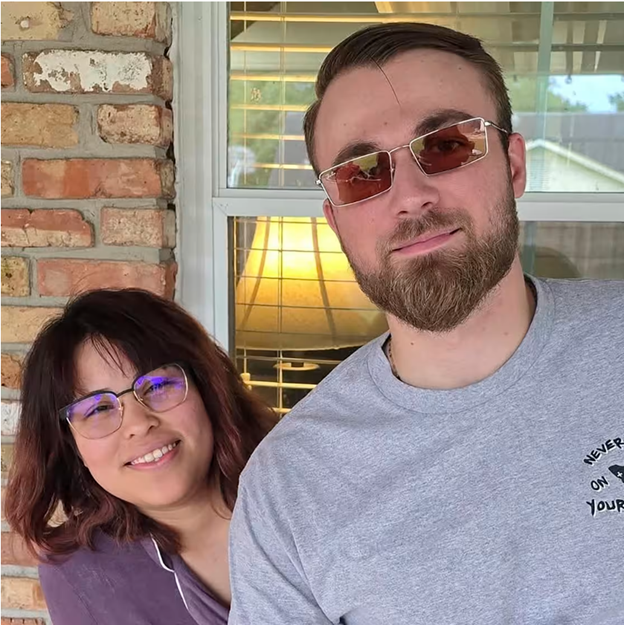
Twice a week, Adrian Clouatre strapped his two children into the car and drove nearly eight hours round-trip from Baton Rouge to Monroe, Louisiana. That was his routine for most of May and June, while his wife, Paola, was being held at an immigrant detention center in another part of the state, facing deportation to Mexico.
Paola, 25, came to the United States at 14 with her mother, who had applied for asylum. A year later, as Adrian recounted in an interview with Louisiana First Investigates, her mother ordered Paola out of their home, leaving her to fend for herself in a strange country. In March of 2022, she met Adrian, a Marine Corpsman stationed in California after service in Korea and Japan. Their first date was at a nightclub in Palm Springs. “We had a great time,” Adrian recalled. “We kept seeing each other after that.”
Two years later, Paola gave birth to their first child, Noah, and the couple were married. Then they embarked on the long process of applying for Paola to become a U.S citizen. They had already passed a key first test, convincing the authorities their marriage was legitimate, when, early this year, Paola came across a TikTok video explaining how to check your immigration status. Following the video’s instructions, she learned that her mother had missed an asylum hearing, triggering a deportation order that covered both of them.
Paola and Adrian laid out this story at her green-card hearing. An honest mistake; marriage to a Marine Corps veteran; two small children, one of them a nine-week-old daughter, still breast-feeding – it was a combination of circumstances that ought to earn them some mercy, they reasoned. The immigration officer who interviewed them seemed sympathetic: “The guy told us we did great, and to wait in the lobby for the paperwork regarding our next appointment,” Adrian said. Just moments later, however, ICE agents emerged with handcuffs and the news that Paola was going to be detained.
She spent the next two months at the privately-run Richwood Corrections Center, eating prison-style food, sleeping on thin mattresses, and keeping strange hours (breakfast was at 4 a.m.) in a facility where people with and without criminal records intermingled indiscriminately. Adrian came as often as he could, he told MSNBC, in order to give Lyn, their youngest, a chance to breastfeed, and Noah, their two-year-old, some time with a mother he desperately missed.
Her stay might have lasted far longer than two months if Adrian had not found a lawyer and succeeded in bringing the family’s story to the notice of Louisiana’s senior Senator, John Kennedy. A Republican and a supporter of the Trump administration’s immigration policies, Kennedy thought the authorities had gone too far in this case. Just days after he shared that sentiment with the Department of Homeland Security, a judge paused Paola’s deportation order, and ICE released her.
Kennedy’s intervention was not enough to save Paola from the indignity of being required to wear an ankle monitor until her next court hearing, which could be many months off. The ankle monitor makes her feel like a criminal “even though I’m not a criminal person,” she told Jen Psaki of MSNBC. “But I’m happy to be home—to hold my kids again.”
Psaki asked her husband if there was anything he might wish to say to the people currently in charge of U.S. immigration policy. He put in a plea for “just a modicum of discretion… at the lower echelons.” In another interview, with People Magazine, Adrian Clouatre explained that the ICE agents who ordered Paola’s detention clearly felt they had no alternative, even though they “knew it was morally wrong.”
Homeland Security Assistant Secretary Tricia McLaughlin was unapologetic. “President Trump and Secretary [Kristi] Noem are not going to ignore the rule of law,” she said in a statement responding to the magazine’s questions about the case.
Posted on November 1, 2025
 weareyourneighbors.net
Leave a comment