
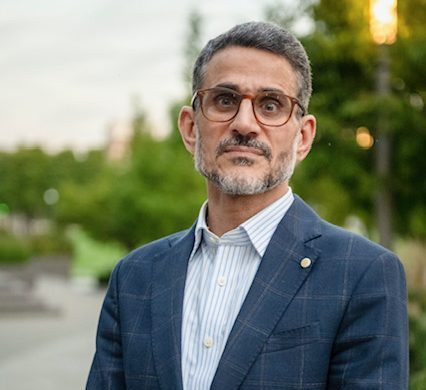
Cincinnati, Ohio
On the morning of July 9, 2025, Ayman Soliman showed up at an Immigration and Customs Enforcement office in suburban Cincinnati. He had checked in with ICE before, usually leaving in minutes. This time was different: Soliman found himself being questioned for nearly three hours by agents of the FBI as well as ICE. At the end of their interrogation, they told him he would be jailed and face deportation to Egypt. The main charge against him: giving “material support” to a “Tier III” terrorist organization.
His Cincinnati friends and co-workers had trouble wrapping their heads around that idea. Soliman had been a chaplain – the first-ever Muslim chaplain – at Cincinnati Children’s Hospital, where he had formed lasting bonds with patients and parents. Taylor McClain had come to know him over the 271 days of her newborn daughter Violette’s stay in the neonatal intensive care unit. McLain considered Soliman “family. She could say “with full confidence,” she told a reporter for ProPublica, that her daughter would not have survived without Soliman’s support and advocacy,
Patients and family members as well as local imams, rabbis and ministers helped mount a campaign of “Free Ayman” petitions and protests. Hospital staffers also got involved, despite warnings from their superiors to watch their words. After a rally that ended with multiple arrests on July 17th, two of Soliman’s fellow chaplains were fired – one for giving an interview, the other just for being there.
All the while, Soliman remained in detention, dreading the prospect of a return to Egypt. Before becoming an imam, he had been a freelance journalist, and his reporting on the Arab Spring movement of 2011 and 2012 had gotten him into repeated trouble with the authorities. At one point, he recalled in a video shot before his detention, he had been jailed and tortured with electric shocks by the military-led government that took power in 2013. “I didn’t come to America seeking a better life,” Soliman said in the video. “I was escaping death.”
After fleeing to the U.S. in 2014, Soliman won a grant of political asylum in 2018. But the Department of Homeland Security had revoked that grant, citing his past involvement with a century-old Egyptian charity, Al-Jameya al-Shar’iyya. Known mostly for running a network of hospitals and orphanages, the group had briefly run afoul of the Egyptian government due to perceived links to the Muslim Brotherhood. As Soliman’s lawyers pointed out, however, Egypt no longer saw Al-Jameya al-Shar’iyya as anything but a legitimate charity, and the Muslim Brotherhood itself had never been officially designated as a terrorist organization – by Egypt or the U.S.,. The case against Soliman, one of his lawyers said, rested on a chain of connections “too tenuous to withstand scrutiny.”
DHS’s lawyers seemed to reach the same conclusion in the end. On September 19th, they withdrew the charges against Soliman, reinstated his asylum status, and set him free. At a press conference later that day, he thanked the many people who had taken up his cause: “Those who posted on social media, those who made noise, every time you held an event, I could see that in the Butler County Jail.”
“I can’t find words to describe this moment,” Soliman told his welcomers. “This is beyond a dream.”
Posted on October 21, 2025
 weareyourneighbors.net