
New York City
“No one has died,” Secretary of State Marco Rubio said in answer to a question, at a Senate hearing in May, about the shutdown of the U.S. Agency for International Development, or USAID.
Jennier Nielsen is in a position to dispute that. During her 18 years as the Senior Nutrition Advisor at Helen Keller Intl, Nielsen saw USAID-funded workers deliver food to places where people had been wasting away from hunger. “We saved lots of lives,” she says. “Those programs are going to vastly diminish. More children are going to die of starvation, and are certainly dying already.”
In addition to its anti-hunger work, Helen Keller runs programs to combat neglected tropical diseases. Those efforts have scored some big successes in recent decades, eliminating illnesses, such as trachoma and onchocerciasis (or river blindness), that once wrecked many lives. Now, says Nielsen, we will see some of those maladies “come surging back.”
USAID was one of the first targets of the Trump administration’s Department of Government Efficiency, or DOGE. Announcing the decision to disband the agency, Elon Musk, DOGE’s leader at the time, said his team had “spent the weekend feeding USAID into the woodchipper.” That move eliminated nearly ninety percent of nutrition and disease-prevention funding and led to drastic reductions in U.S. support for the AIDS relief program, known as PEPFAR, that has been credited with saving more than 25 million lives since it was launched in 2003 under President George W. Bush.
Public-health researchers have tried to estimate the number of deaths linked to the dismantling of USAID. It’s not easy, , adding that “the only debate is whether to measure the dead in the thousands, tens of thousands or hundreds of thousands.” It’s not easy to determine how many people have died as a result of USAID’s shutdown. Brooke Nichols, a Boston University epidemiologist, puts the number of fatalities at between 600,000 and 700,000, with children accounting for roighly two-thirds of that total. The White House said it was going after USAID in the name of eliminating “waste and abuse.” As a result of the agency’s dismantling, Nicholas Kristof of the New York Times has pointed out, many millions of dollars of life-saving medicine are now sitting in warehouses “gathering dust, and some of them are approaching their expiration date and may have to be destroyed, at very significant cost, because the Trump administration canceled the program to distribute them.”
Jennifer Nielsen’s job was another casualty of the decision to get rid of USAID. She was a “workaholic,” she says, often putting in nine or ten hours a day because she found the work so fulfilling. She points out that U.S. foreign aid, while adding up to less than one percent of the federal budget, played a part in reducing extreme poverty and pregnancy-related deaths by about half over the past three decades.
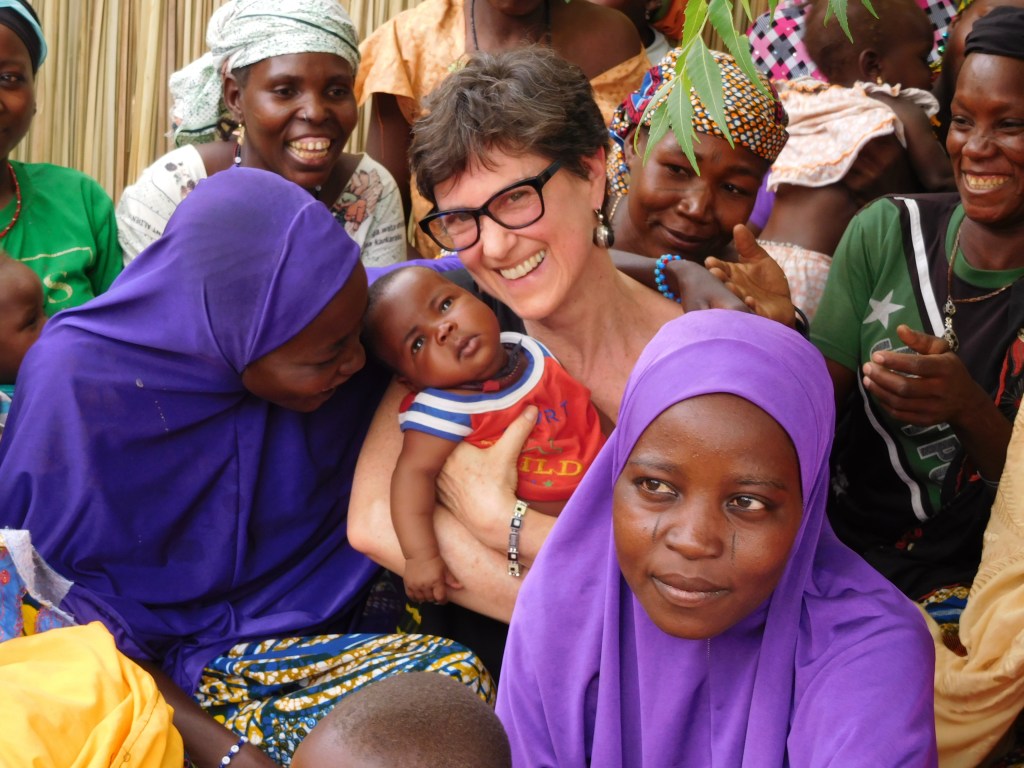
Nielsen treasures a photograph of herself with a group of women in the West African nation of Niger. She had gone there to help evaluate a program intended to improve nutrition and bring greater food security while building a team of local anti-hunger workers. The photograph reminds her of their excitement over their newfound knowledge – and their gratitude for America’s support. “If only I could bring people to meet the communities where I worked,” Nielsen says. “Because they are so full of love for their children.”
Updated on January 17, 2026
 weareyourneighbors.net
Leave a comment